Amnesty International has just published a 94-page report entitled “Caught in a web of repression: Iran’s human rights defenders under attack.” It details 45 specific instances of what the organization has described as a “vicious crackdown” coinciding with the supposedly moderate presidency of Hassan Rouhani, who begins his second term in office this week.
The overall takeaway is that Iranian authorities have repeatedly diminished the standards by which they accuse and convict activists and dissenters of national security crimes, while also increasing the severity of punishments that are meted out to those same people. The abusive nature of those punishments was reinforced by new revelations that emerged alongside the Amnesty International report, mainly regarding the Islamic Republic’s notorious overuse of the death penalty.
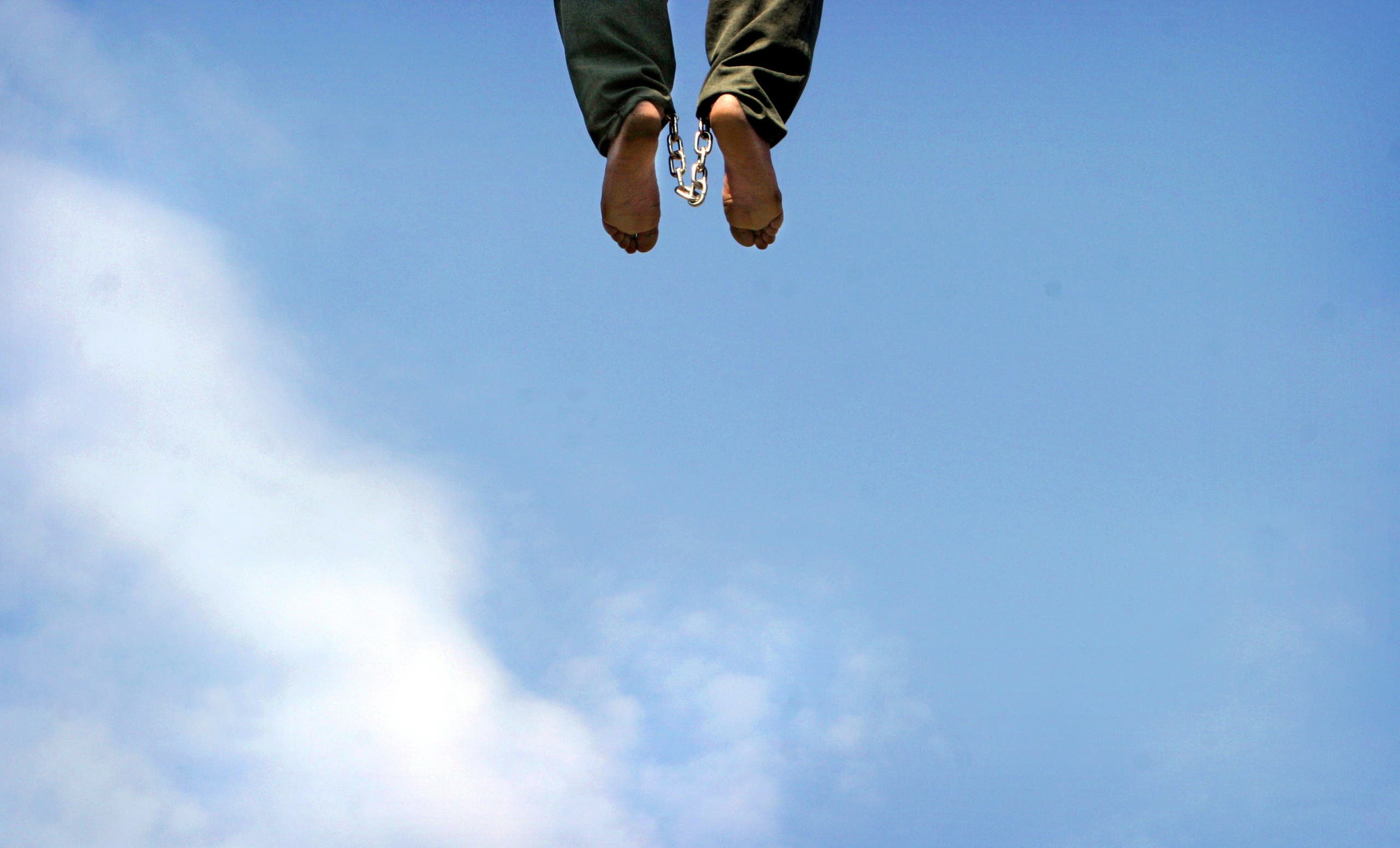
Iran has long maintained world-leading rates of execution, and the violence and repression of the past few years have been reflected in a pattern of hangings that includes periodic spikes during which dozens of people are put to death in a single month. Last month saw just such a spike, with at least 101 death sentences being carried out, to say nothing of those that might have gone ahead in secret.
The Iranian Human Rights Organization announced that the Iranian authorities executed over one hundred people during the month of July. (File photo: Reuters)
In Iran, political prisoners are sentenced to hang with some frequency, usually on the basis of vague, religious charges like “enmity against God” or “insulting the sacred.”
Repressive, theocratic regime
Executions speak to the repressive nature of the theocratic regime, which has only grown worse in the era of Rouhani, when the government is fractured between two factions, neither of which represents reform. Maryam Rajavi, the president of the leading coalition of Iranian dissidents, the National Council of Resistance of Iran, responded to the new death penalty figures by saying, “Beset by crises and fearing popular uprisings, Iran’s ruling theocracy has found no other way out but to escalate repression especially by mass and arbitrary executions.”
The NCRI statement went on to recommend that the international community disregard economic and political incentives to expand relations with the Islamic Republic, and instead undertake measures to hold its officials accountable not only for recent crackdowns and executions, but also for long-neglected past crimes, like the massacre of some 30,000 political prisoners in the summer of 1988.
Naturally, being “beset by crises” and the possibility of popular overthrow, the regime is deeply fearful of this sort of pressure, which would imply Western readiness to stand behind a domestic uprising in Iran, and to aid it by making sure that Tehran is not free to carry out reprisals against dissenters as it sees fit.
Absurd claim
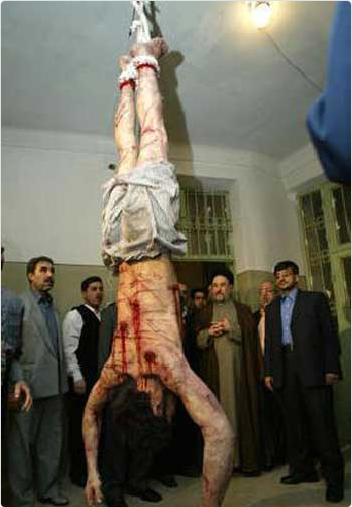
Last month, Iran’s own so-called human rights monitor, Javad Larijani, made the absurd claim that the country does not hold any political prisoners. Immediately thereafter, foreign diplomats in Tehran were taken on a tour of the notorious Evin Prison, but human rights investigators were kept far away from the public relations stunt, while the diplomats were kept far away from wards that are known to house political prisoners almost exclusively.
Iranian Foreign Minister Javad Zarif has made similarly bold, easily ridiculed statements asserting the country’s innocence. But with or without the new Amnesty International report, no one with a modicum of knowledge of the Islamic Republic should ever take such claims seriously. Unfortunately, Zarif and other members of the Rouhani administration appear to be masterful at putting a friendly face on Iran’s clerical regime, even as its domestic abuses and foreign provocations continue to escalate.
Justice will only be achieved when the international community has the courage to reject Iran’s absurd, anemic denials and to instead respond with new economic and diplomatic pressure to the regime’s human rights abuses.
Struan Stevenson
This is the only explanation for the fact that some Western officials, including European Union foreign policy chief Federica Mogherini, agreed to attend this week’s re-inauguration of President Rouhani. These decisions were profoundly misguided, insofar as any Western presence at an Iranian state function presupposes that the relevant officials are turning a blind eye to human rights abuses that are not only continuing but escalating on Rouhani’s watch.
It is simply inconceivable that any of those officials are unaware of the information being shared by Amnesty and others. The most charitable explanation for their actions is that they do not hold Rouhani personally responsible for the crackdowns and are willing to offer their support to his administration in the hope that it will finally, after four years in office, begin to promote serious domestic reforms.
But if this is their thinking, it is painfully naïve. Rouhani has never been anything other than a loyal servant of the regime that tortures its citizens and imprisons them for upwards of 10 years simply for protesting previous human rights abuses. Soon after taking office in 2013 amidst the applause of Western officials, Rouhani thoroughly turned his back on human rights by appointing Mostafa Pourmohammadi, a leading figure in the 1988 massacre, as his justice minister.
Such officials must be brought to justice, lest the Iranian regime be convinced that it can get away with thousands of unlawful killings and still enjoy the presence of friendly European faces at its state functions. Justice will only be achieved when the international community has the courage to reject Iran’s absurd, anemic denials and to instead respond with new economic and diplomatic pressure to the regime’s human rights abuses.
__________________ Struan Stevenson is president of the European Iraqi Freedom Association (EIFA). He was a member of the European Parliament representing Scotland (1999-2014), president of the Parliament's Delegation for Relations with Iraq (2009-14) and chairman of Friends of a Free Iran Intergroup (2004-14). He is an international lecturer on the Middle East..
LEADING OFFICIALS OF IRANIAN REGIME ADMIT THE MASSACRE OF MEK MEMBERS
Written by Jazeh Miller
Iranian regime massacred over 30,000 political prisoners in summer of 1988, and kept silent about this atrocity for three decades. Most of the victims were members and supports of the main opposition group the People’s Mojahedin Organization of Iran (PMOI/MEK). This year in the presidential election as conservative cleric Ebrahim Raisie, one of the perpetrators of the massacre, was selected as one of the main candidates, the issue surfaced, forcing regime officials, one after another, to confess about the carnage.
Last week in an unprecedented interview, Ali Fallahian, the former Iranian intelligence Minister, revealed the mindset behind the mass execution of summer of 1988. Ali Fallahian, who was called as “the most feared mullah in Iran” by the News Week is wanted by Interpol for his involvement in the AMIA bombing that killed 85 people on July 18, 1994 in Buenos Aires, Argentina.
In the interview, Fallahian explained that whoever had any relation with the MEK was condemned to death.
"Regarding MEK and all the militant groups, the ruling is the death sentence ... Imam (Khomeini) has said this ... their verdict is death sentence ... Fallahian said in the interview.
“Mr. Mousavi (Tabrizi) who was the Revolution’s general prosecutor used to say that there is no need for trial at all ... it makes no sense that we try them ... Imam repeatedly insisted that you should be careful not to let them go... Imam continuously stressed that you should always be cautious of this matter ... Their ruling is always execution. This was his (Khomeini’s) verdict as the supreme leader, both before and after this event of 1988 (massacre of political prisoners).” Fallahian said in the interview referring to MEK members and supporters.
" First, you should bear in mind that their (MEK’s) ruling was death punishment; and if the religious judge did not sentence them (MEK) to death, his ruling has been illegal ... so all of us should acknowledge that the verdict for a Monafeq [the term used by the regime to call a MEK member or sympathizer] is death sentence, this was both Imam’s fatwa and his verdict... there was a discussion about those who were supposed to be executed, but the executions did not carry out, and those who were to be executed but didn’t get a verdict. ‘Nonetheless’ why they were kept alive against Imam’s (Khomeini) will? “Fallahian said, responding to a question about the victims of the massacres of 1988 (MEK members and supporters) who were serving their sentences.
"When someone is a member of a military group, and that group is fighting with us, regardless of whether that person is armed or not, he is one of them (and should be executed).” Fallahian said referring to MEK members.
In the summer of 1988 Khomeini, the supreme leader of regime issued a religious decree calling for the massacre.
“Whoever at any stage continues to belong to the (PMOI/MEK) must be executed. Annihilate the enemies of Islam immediately!...Those who are in prisons throughout the country and remain steadfast in their support for the MEK are waging war on God, and are condemned to execution…It is naive to show mercy to those who wage war on God,” reads part of the decree.
A committee of four men was formed to implement the order, and in a matter of few months over 30,000 political prisoners were executed, mostly members and supporters of the MEK.
Fallahian is not the only official confessing to the massacre of political prisoners and MEK members and supporters. Ahmad Khatami, a board member of the regime’s Assembly of Experts, in Tehran Friday prayers sermon called for the perpetrators of the massacre of MEK members to be awarded medals.
Mullah Abbasian, another Friday prayers imam, made similar remarks and said:
“During the election season we witnessed how a number of people sought to change the MEK’s image and criticized those who stood against the MEK… Hat’s off to the judge who executed MEK members” Earlier this month in an interview with a state news agency Ali Razini, the head of Branch 41 of the Supreme Court – said that the execution of prisoners in 1988 in what has been named the 1988 massacre was “fair” and “lawful”. In the interview he confessed that the objective of the massacre was to uproot the MEK.
“Rulings by the top 20 judges and I ensured the country’s security at that time and ever since. As a consequence, the MEK can never establish itself here. We nipped them in the bud.”
Razini said referring to the rulings of massacre of thousands of MEK members.
Last week a number of political prisoners in Rajai Shahr prison in Karaj in a letter to UN Human Rights council wrote: “The formation of a committee to investigate the massacre in 1988 is necessary not only for the same crimes and prosecution of the perpetrators, but also for preventing repeat of such atrocities. The fact is that the number of executions and human rights violations in Iran are still catastrophic, as the perpetrators of those crimes were not held accountable or punished...”
Marking the 29th anniversary of this horrific purge, the time has come to hold the mullah’s regime accountable for crimes against humanity.
*****
More about MEK:
A Long Conflict between the Clerical Regime and the MEK
The origins of the MEK date back to before the 1979 Iranian Revolution., the MEK helped to overthrow the dictatorship of Shah Reza Pahlavi, but it quickly became a bitter enemy of the emerging the religious fascism under the pretext of Islamic Republic. To this day, the MEK and NCRI describe Ruhollah Khomenei and his associates as having co-opted a popular revolution in order to empower themselves while imposing a fundamentalist view of Islam onto the people of Iran.
Under the Islamic Republic, the MEK was quickly marginalized and affiliation with it was criminalized. Much of the organization’s leadership went to neighboring Iraq and built an exile community called Camp Ashraf, from which the MEK organized activities aimed at ousting the clerical regime and bringing the Iranian Revolution back in line with its pro-democratic origins. But the persistence of these efforts also prompted the struggling regime to crack down with extreme violence on the MEK and other opponents of theocratic rule.
The crackdowns culminated in the massacre of political prisoners in the summer of 1988, as the Iran-Iraq War was coming to a close. Thousands of political prisoners were held in Iranian jails at that time, many of them having already served out their assigned prison sentences. And with the MEK already serving as the main voice of opposition to the regime at that time, its members and supporters naturally made up the vast majority of the population of such prisoners.
As the result of a fatwa handed down by Khomeini, the regime convened what came to be known as the Death Commission, assigning three judges the task of briefly interviewing prisoners to determine whether they retained any sympathy for the MEK or harbored any resentment toward the existing government. Those who were deemed to have shown any sign of continued opposition were sentenced to be hanged. After a period of about three months, an estimated 30,000 people had been put to death. Many other killings of MEK members preceded and followed that incident, so that today the Free Iran rally includes an annual memorial for approximately 120,000 martyrs from the People’s Mojahedin Organization of Iran.
The obvious motive behind the 1988 massacre and other such killings was the destruction of the MEK. And yet it has not only survived but thrived, gaining allies to form the NCRI and acquiring the widespread support that is put on display at each year’s Free Iran rally. In the previous events, the keynote speech was delivered by Maryam Rajavi, who has been known to receive several minutes of applause from the massive crowd as she takes the stage. Her speeches provide concrete examples of the vulnerability of the clerical regime and emphasize the ever-improving prospects for the MEK to lead the way in bringing about regime change.
The recipients of that message are diverse and they include more than just the assembled crowd of MEK members and supporters. The expectation is that the international dignitaries at each year’s event will carry the message of the MEK back to their own governments and help to encourage more policymakers to recognize the role of the Iranian Resistance in the potential creation of a free and democratic Iranian nation. It is also expected that the event will inspire millions of Iranians to plan for the eventual removal of the clerical regime. And indeed, the MEK broadcasts the event via its own satellite television network, to millions of Iranian households with illegal hookups.
MEK’s Domestic Activism and Intelligence Network
What’s more, the MEK retains a solid base of activists inside its Iranian homeland. In the run-up to this year’s Free Iran rally the role of those activists was particularly evident, since the event comes just a month and a half after the latest Iranian presidential elections, in which heavily stage-managed elections resulted in the supposedly moderate incumbent Hassan Rouhani securing reelection. His initial election in 2013 was embraced by some Western policymakers as a possible sign of progress inside the Islamic Republic, but aside from the 2015 nuclear agreement with six world powers, none of his progressive-sounding campaign promises have seen the light of day.
Rouhani’s poor record has provided additional fertile ground for the message of the MEK and Maryam Rajavi. The Iranian Resistance has long argued that change from within the regime is impossible, and this was strongly reiterated against the backdrop of the presidential elections, when MEK activists used graffiti, banners, and other communications to describe the sitting president as an “imposter.” Many of those same communications decried Rouhani’s leading challenger, Ebrahim Raisi, as a “murderer,” owing to his leading role in the massacre of MEK supporters in 1988.
That fact helped to underscore the domestic support for the People’s Mojahedin Organization of Iran, insofar as many people who participated in the election said they recognized Raisi as the worst the regime had to offer, and that they were eager to prevent him from taking office. But this is not to say that voters saw Rouhani in a positive light, especially where the MEK is concerned. Under the Rouhani administration, the Justice Minister is headed by Mostafa Pourmohammadi, who also served on the Death Commission and declared as recently as last year that he was proud of himself for having carried out what he described as God’s command of death for MEK supporters.
With this and other aspects of the Islamic Republic’s record, the MEK’s pre-election activism was mainly focused on encouraging Iranians to boycott the polls. The publicly displayed banners and posters urged a “vote for regime change,” and many of them included the likeness of Maryam Rajavi, suggesting that her return to Iran from France would signify a meaningful alternative to the hardline servants of the clerical regime who are currently the only option in any Iranian national election.
Naturally, this direct impact on Iranian politics is the ultimate goal of MEK activism. But it performs other recognizable roles from its position in exile, not just limited to the motivational and organization role of the Free Iran rally and other, smaller gatherings. In fact, the MEK rose to particular international prominence in 2005 when it released information that had been kept secret by the Iranian regime about its nuclear program. These revelations included the locations of two secret nuclear sites: a uranium enrichment facility at Natanz and a heavy water plant at Arak, capable of producing enriched plutonium.
As well as having a substantial impact on the status of international policy regarding the Iranian nuclear program, the revelations also highlighted the MEK’s popular support and strong network inside Iran. Although Maryam Rajavi and the rest of the leadership of the People’s Mojahedin Organization of Iran reside outside of the country, MEK affiliates are scattered throughout Iranian society with some even holding positions within hardline government and military institutions, including the Iranian Revolutionary Guard Corps.
Drawing upon the resources of that intelligence network, the MEK has continued to share crucial information with Western governments in recent years, some of it related to the nuclear program and some of it related to other matters including terrorist training, military development, and the misappropriation of financial resources. The MEK has variously pointed out that the Revolutionary Guard controls well over half of Iran’s gross domestic product, both directly and through a series of front companies and close affiliates in all manner of Iranian industries.
In February of this year, the Washington, D.C. office of the National Council of Resistance of Iran held press conferences to detail MEK intelligence regarding the expansion of terrorist training programs being carried out across Iran by the Revolutionary Guards. The growth of these programs reportedly followed upon direct orders from Iranian Supreme Leader Ali Khamenei and coincided with increased recruitment of foreign nationals to fight on Tehran’s behalf in regional conflicts including the Syrian and Yemeni civil wars.
In the weeks following that press conference, the MEK’s parent organization also prepared documents and held other talks explaining the source of some of the Revolutionary Guards’ power and wealth. Notably, this series of revelations reflected upon trends in American policy toward the Islamic Republic of Iran. And other revelations continue to do so, even now.
MEK Intelligence Bolstering US Policy Shifts
Soon after taking office, and around the time the MEK identified a series of Revolutionary Guard training camps, US President Donald Trump directed the State Department to review the possibility of designating Iran’s hardline paramilitary as a foreign terrorist organization. Doing so would open the Revolutionary Guards up to dramatically increased sanctions – a strategy that the MEK prominently supports as a means of weakening the barriers to regime change within Iran.
The recent revelations of the People’s Mojahedin Organization of Iran have gone a long way toward illustrating both the reasons for giving this designation to the Revolutionary Guards and the potential impact of doing so. Since then, the MEK has also used its intelligence gathering to highlight the ways in which further sanctioning the Guards could result in improved regional security, regardless of the specific impact on terrorist financing.
For example, in June the NCRI’s Washington, D.C. office held yet another press conference wherein it explained that MEK operatives had become aware of another order for escalation that had been given by Supreme Leader Khamenei, this one related to the Iranian ballistic missile program. This had also been a longstanding point of contention for the Trump administration and the rest of the US government, in light of several ballistic missile launches that have been carried out since the conclusion of nuclear negotiations, including an actual strike on eastern Syria.
That strike was widely viewed as a threatening gesture toward the US. And the MEK has helped to clarify the extent of the threat by identifying 42 separate missile sites scattered throughout Iran, including one that was working closely with the Iranian institution that had previously been tasked with weaponizing aspects of the Iranian nuclear program.
The National Council of Resistance of Iran (NCRI) led by Maryam Rajavi is thus going to great lengths to encourage the current trend in US policy, which is pointing to more assertiveness and possibly even to the ultimate goal of regime change. The MEK is also striving to move Europe in a similar direction, and the July 1 gathering is likely to show further progress toward that goal. This is because hundreds of American and European politicians and scholars have already declared support for the NCRI and MEK and the platform of Maryam Rajavi. The number grows every year, while the People’s Mojahedin Organization of Iran continues to collect intelligence that promises to clarify the need for regime change and the practicality of their strategy for achieving it.
REGIME CHANGE IN IRAN AT REACH WITH THE ONLY ORGANIZED OPPOSITION (PMOI/MEK)
By INU Staff
INU - When confronted with the question of whether the Trump administrations backs regime change in Iran, Secretary of State Rex Tillerson said Washington would work with Iranian opposition groups to reach “peaceful transition of that government.”
The most organized and renowned Iranian opposition group is none other than the National Council of Resistance of Iran (NCRI) with the People's Mojahedin Organization of Iran (PMOI/MEK) being the core member of this coalition.
The MEK enjoys vast support both inside Iran and abroad, especially an unmatched network of activists who dare to show their support for NCRI President Maryam Rajavi and her movement at whatever opportunity.
Sen. John McCain (R-Ariz.) echoed Tillerson’s view, saying “it’s time the Iranian people had a free and open society and a functioning democracy,” effectively a call for regime change.
Just months ago Senator McCain paid a visit to Albania where most MEK members are currently stationed after a long ordeal in Iraq. The MEK was the target of numerous attacks by Iran-backed proxy groups and even the government of former Prime Minister Nouri al-Maliki prior to their departure of this country in 2016.
On July 1, a major convention was held in Paris where hundreds of political dignitaries from across the globe explicitly called for regime change in Iran and supporting the NCRI and MEK.
The MEK’s vast popular base was proven as over 100,000 members of the Iranian Diaspora rushed to Paris to express their support for Maryam Rajavi, the MEK and a free and democratic Iran.
Trump allies, including John Bolton, former U.S. ambassador to the United Nations during the George W. Bush administration were present and voiced their support for the convention’s cause.
“There is a viable opposition to the rule of the ayatollahs, and that opposition is centered in this room today. I had said for over 10 years since coming to these events, that the declared policy of the United States of America should be … to change the regime itself. And that’s why, before 2019, we here will celebrate in Tehran!”
We are currently at a period of analysis as the President’s National Security Council reviews Washington’s Iran policy.
The best and most realistic option before the Trump administration is supporting the pro-democracy coalition of dissidents, the NCRI, which is best able to mobilize other opposition groups into an even broader coalition. This, coupled with the MEK’s vast domestic network inside Iran, pose a major threat for the ruling regime in Tehran.
In his visit to Riyadh, President Trump also expressed strong views about extremist groups, sending a stark message to those supporting such entities.
“Drive them out of your places of worship,” Trump said of extremists, “drive them out of your holy land. Drive them out of this earth.”
After the July 1 convention in Paris, reports seen the next day indicated Trump might defy Tehran by signaling his willingness to consider supporting the Iranian opposition.
Iranian people and their resistance, with the NCRI and MEK at the helm, will bring about the “regime change from within.” And that is where U.S. and international support will help.
Washington benefits from aligning with the Iranian opposition NCRI and MEK because this resistance is seeking regime change to bring about democracy and freedom for the Iranian people, and the region, and merely peace and security for the whole world by rooting out the central exporter of terrorism and Islamic extremism. Which is the religious fascism ruling Iran.
Thus, President Trump has before him the option of reaching out to the Iranian opposition during his review of Iran policy.
More about MEK
A Long Conflict between the Clerical Regime and the MEK
The origins of the MEK date back to before the 1979 Iranian Revolution., the MEK helped to overthrow the dictatorship of Shah Reza Pahlavi, but it quickly became a bitter enemy of the emerging the religious fascism under the pretext of Islamic Republic. To this day, the MEK and NCRI describe Ruhollah Khomenei and his associates as having co-opted a popular revolution in order to empower themselves while imposing a fundamentalist view of Islam onto the people of Iran.
Under the Islamic Republic, the MEK was quickly marginalized and affiliation with it was criminalized. Much of the organization’s leadership went to neighboring Iraq and built an exile community called Camp Ashraf, from which the MEK organized activities aimed at ousting the clerical regime and bringing the Iranian Revolution back in line with its pro-democratic origins. But the persistence of these efforts also prompted the struggling regime to crack down with extreme violence on the MEK and other opponents of theocratic rule.
The crackdowns culminated in the massacre of political prisoners in the summer of 1988, as the Iran-Iraq War was coming to a close. Thousands of political prisoners were held in Iranian jails at that time, many of them having already served out their assigned prison sentences. And with the MEK already serving as the main voice of opposition to the regime at that time, its members and supporters naturally made up the vast majority of the population of such prisoners.
As the result of a fatwa handed down by Khomeini, the regime convened what came to be known as the Death Commission, assigning three judges the task of briefly interviewing prisoners to determine whether they retained any sympathy for the MEK or harbored any resentment toward the existing government. Those who were deemed to have shown any sign of continued opposition were sentenced to be hanged. After a period of about three months, an estimated 30,000 people had been put to death. Many other killings of MEK members preceded and followed that incident, so that today the Free Iran rally includes an annual memorial for approximately 120,000 martyrs from the People’s Mojahedin Organization of Iran.
The obvious motive behind the 1988 massacre and other such killings was the destruction of the MEK. And yet it has not only survived but thrived, gaining allies to form the NCRI and acquiring the widespread support that is put on display at each year’s Free Iran rally. In the previous events, the keynote speech was delivered by Maryam Rajavi, who has been known to receive several minutes of applause from the massive crowd as she takes the stage. Her speeches provide concrete examples of the vulnerability of the clerical regime and emphasize the ever-improving prospects for the MEK to lead the way in bringing about regime change.
The recipients of that message are diverse and they include more than just the assembled crowd of MEK members and supporters. The expectation is that the international dignitaries at each year’s event will carry the message of the MEK back to their own governments and help to encourage more policymakers to recognize the role of the Iranian Resistance in the potential creation of a free and democratic Iranian nation. It is also expected that the event will inspire millions of Iranians to plan for the eventual removal of the clerical regime. And indeed, the MEK broadcasts the event via its own satellite television network, to millions of Iranian households with illegal hookups.
MEK’s Domestic Activism and Intelligence Network
What’s more, the MEK retains a solid base of activists inside its Iranian homeland. In the run-up to this year’s Free Iran rally the role of those activists was particularly evident, since the event comes just a month and a half after the latest Iranian presidential elections, in which heavily stage-managed elections resulted in the supposedly moderate incumbent Hassan Rouhani securing reelection. His initial election in 2013 was embraced by some Western policymakers as a possible sign of progress inside the Islamic Republic, but aside from the 2015 nuclear agreement with six world powers, none of his progressive-sounding campaign promises have seen the light of day.
Rouhani’s poor record has provided additional fertile ground for the message of the MEK and Maryam Rajavi. The Iranian Resistance has long argued that change from within the regime is impossible, and this was strongly reiterated against the backdrop of the presidential elections, when MEK activists used graffiti, banners, and other communications to describe the sitting president as an “imposter.” Many of those same communications decried Rouhani’s leading challenger, Ebrahim Raisi, as a “murderer,” owing to his leading role in the massacre of MEK supporters in 1988.
That fact helped to underscore the domestic support for the People’s Mojahedin Organization of Iran, insofar as many people who participated in the election said they recognized Raisi as the worst the regime had to offer, and that they were eager to prevent him from taking office. But this is not to say that voters saw Rouhani in a positive light, especially where the MEK is concerned. Under the Rouhani administration, the Justice Minister is headed by Mostafa Pourmohammadi, who also served on the Death Commission and declared as recently as last year that he was proud of himself for having carried out what he described as God’s command of death for MEK supporters.
With this and other aspects of the Islamic Republic’s record, the MEK’s pre-election activism was mainly focused on encouraging Iranians to boycott the polls. The publicly displayed banners and posters urged a “vote for regime change,” and many of them included the likeness of Maryam Rajavi, suggesting that her return to Iran from France would signify a meaningful alternative to the hardline servants of the clerical regime who are currently the only option in any Iranian national election.
Naturally, this direct impact on Iranian politics is the ultimate goal of MEK activism. But it performs other recognizable roles from its position in exile, not just limited to the motivational and organization role of the Free Iran rally and other, smaller gatherings. In fact, the MEK rose to particular international prominence in 2005 when it released information that had been kept secret by the Iranian regime about its nuclear program. These revelations included the locations of two secret nuclear sites: an uranium enrichment facility at Natanz and a heavy water plant at Arak, capable of producing enriched plutonium.
As well as having a substantial impact on the status of international policy regarding the Iranian nuclear program, the revelations also highlighted the MEK’s popular support and strong network inside Iran. Although Maryam Rajavi and the rest of the leadership of the People’s Mojahedin Organization of Iran reside outside of the country, MEK affiliates are scattered throughout Iranian society with some even holding positions within hardline government and military institutions, including the Iranian Revolutionary Guard Corps.
Drawing upon the resources of that intelligence network, the MEK has continued to share crucial information with Western governments in recent years, some of it related to the nuclear program and some of it related to other matters including terrorist training, military development, and the misappropriation of financial resources. The MEK has variously pointed out that the Revolutionary Guard controls well over half of Iran’s gross domestic product, both directly and through a series of front companies and close affiliates in all manner of Iranian industries.
In February of this year, the Washington, D.C. office of the National Council of Resistance of Iran held press conferences to detail MEK intelligence regarding the expansion of terrorist training programs being carried out across Iran by the Revolutionary Guards. The growth of these programs reportedly followed upon direct orders from Iranian Supreme Leader Ali Khamenei and coincided with increased recruitment of foreign nationals to fight on Tehran’s behalf in regional conflicts including the Syrian and Yemeni civil wars.
In the weeks following that press conference, the MEK’s parent organization also prepared documents and held other talks explaining the source of some of the Revolutionary Guards’ power and wealth. Notably, this series of revelations reflected upon trends in American policy toward the Islamic Republic of Iran. And other revelations continue to do so, even now.
MEK Intelligence Bolstering US Policy Shifts
Soon after taking office, and around the time the MEK identified a series of Revolutionary Guard training camps, US President Donald Trump directed the State Department to review the possibility of designating Iran’s hardline paramilitary as a foreign terrorist organization. Doing so would open the Revolutionary Guards up to dramatically increased sanctions – a strategy that the MEK prominently supports as a means of weakening the barriers to regime change within Iran.
The recent revelations of the People’s Mojahedin Organization of Iran have gone a long way toward illustrating both the reasons for giving this designation to the Revolutionary Guards and the potential impact of doing so. Since then, the MEK has also used its intelligence gathering to highlight the ways in which further sanctioning the Guards could result in improved regional security, regardless of the specific impact on terrorist financing.
For example, in June the NCRI’s Washington, D.C. office held yet another press conference wherein it explained that MEK operatives had become aware of another order for escalation that had been given by Supreme Leader Khamenei, this one related to the Iranian ballistic missile program. This had also been a longstanding point of contention for the Trump administration and the rest of the US government, in light of several ballistic missile launches that have been carried out since the conclusion of nuclear negotiations, including an actual strike on eastern Syria.
That strike was widely viewed as a threatening gesture toward the US. And the MEK has helped to clarify the extent of the threat by identifying 42 separate missile sites scattered throughout Iran, including one that was working closely with the Iranian institution that had previously been tasked with weaponizing aspects of the Iranian nuclear program.
The National Council of Resistance of Iran (NCRI) led by Maryam Rajavi is thus going to great lengths to encourage the current trend in US policy, which is pointing to more assertiveness and possibly even to the ultimate goal of regime change. The MEK is also striving to move Europe in a similar direction, and the July 1 gathering is likely to show further progress toward that goal. This is because hundreds of American and European politicians and scholars have already declared support for the NCRI and MEK and the platform of Maryam Rajavi. The number grows every year, while the People’s Mojahedin Organization of Iran continues to collect intelligence that promises to clarify the need for regime change and the practicality of their strategy for achieving it.
How blood of innocents has become an endless nightmare for Iranian regime
By F. MahmoudiSpecial to Al Arabiya EnglishThursday, 27 July 2017
In Iran, 1980s is known as a bloody decade as thousands of political opponents were executed in brutal mass murder.
In the summer of 1988, a massive slaughter took place in Iran’s prisons. Ayatollah Hossein Ali Montazeri, the successor of Khomeini, was dismissed as a result of his objection to this massacre.
In September 2016, an audio tape from a meeting of the late Ayatollah Montazeri with members of the committee of executioners (commonly known by Iranians as death committee) was published by his son, which led to his arrest and prosecution.
Ayatollah Montazeri
In the audio tape, Ayatollah Montazeri described this massacre as the worst crime in the history of the Islamic Republic, and named Ibrahim Raisi, Mostafa Pour Mohammadi, Hossein Ali Nayeri and other coordinators as criminals.
Judgment against Islam
In a recent TV interview, Ali Fallahian, the minister of intelligence during the Rafsanjani government, said: “The view of Mr. Montazeri, who disagreed with Imam (Khomeini), was that these executions will ultimately cause a “historical judgment” against us, a judgement against Islam, so it is to our benefit not to conduct these executions, but Imam said that you must perform your religious duty and don’t wait for the judgment of history.”
Ali Fahllahian
The families of victims of 1988 massacre are currently seeking justice for their loved ones who were secretly executed and buried in mass graves at nights without any due process. The call for justice led by Iranian opposition, which started last year, caused a challenge for both of the regime’s factions during the presidential elections.
The created chaos between regime’s factions forced Khamenei to comment in a recent speech that “no one should be allowed to change the place of martyr and henchman in relation to the executions of the 1980s.”
What he meant was that the heads of this government are executioners in the eyes of the Iranian people, and this will create internal and international consequences that must be avoided.
Nimrooz movie
Additionally, state-controlled media released Khamenei’s praises about the “Nimrooz” movie, a production funded by the Iran revolutionary guard corps (IRGC) aimed at demonizing the People’s Mojahedin Organization of Iran (PMOI/MEK), a prominent opposition movement. The reason of making this film was to prevent another uprising similar to 2009, in which the MEK played a pivotal role in organizing protests against the regime.
After the release of the film, former political prisoners and families of executed prisoners condemned the events showed during this film and called it as a distortion of the reality in history.
In another hasty event, the Iranian regime put up a show, a tour of Evin Prison, to international delegations. The purpose of holding this tour for 50 ambassadors of different countries on July 5 was to destroy and wash the traces of the regime’s crimes. Amnesty International called this tour a “crude PR Stunt” and mentioned in a statement that Evin prison is known in the world as a symbol of wide political oppression in Iran.
Evin Prison infamous
The executed prisoners of the 1980s were members and supporters of opposition groups of the Iranian regime, such as the MEK, Marxists and Kurds. MEK members and supporters accounted for more than 90 percent of the victims. Beleaguered in Iraq in the post 2003 era, the MEK experienced a very difficult and dangerous situation, particularly over the last decade.
Under such circumstances this movement has been able to attract public sympathy through mass media, especially satellite and Internet. Currently, the Iranians and the International communities have become curious to acquire knowledge about this movement.
Inhuman seige
In face of an inhumane siege and the looming danger of further massacres, members of MEK put up a heroic persistence and defended themselves with bare hands and survived the many plots of their enemies. Eventually, the MEK members exited Iraq and resettled in Albania. Now, the MEK is finding a fast-growing following in Iran, especially among the youth, creating a serious challenge for the Iranian regime.
With the rise of the call for justice for 1988 massacre, the Iranian regime is trying to destroy the evidence of this brutal murder and discourage the youth from joining the opposition movement. It has produced a propaganda film to change the place of martyr and executioner, and destroyed the mass graves of executed prisoners.
The Iranian youth, even the children of regime officials, want to know the reality and the truth of what happened in the 1980s, and the history of the movement that recently held a huge gathering in Paris. Also, they want to know what message it conveys for them.
Meanwhile, Khamenei has ordered to produce another film for Assadollah Lajevardi, the former head of Evin prison known as “Evin hangman,” who was one of the criminals 1988 massacre. “Hopefully, you can do something for Lajevardi as well. He is one of the figures who deserves something. His name was mentioned in this film, but he is one of the persons that we called him ‘strong man’ before,” Khamenei said.
It seems the spilled blood of the innocents who were ruthlessly murdered in Iran is now undermining the foundations and the very existence of the Iranian regime. Sympathy for the victims and their family has now penetrated the depths of the Iranian society and has become an endless nightmare for regime.
INU - Following the ignominy of the movie “Adventure of Nimrooz (Midday Adventure)", made against the People’s Mujahedin Organization of Iran ( PMOI/MEK), the news agency of the Islamic Revolutionary Guards (IRGC) released the news about the meeting of Iranian regime's Supreme Leader Ali Khamenei with film producers which exposes Khamenei’s role in the production of this movie. The IRGC was also involved in the production of the movie in February/March 2017.
The news was first released by the IRGC following confessions and protests among various government bands due to the ignominy of this scandalous film. It was then published by other state-run news agencies.
According to state-run news agencies, Khamenei who was after production of this movie against the MEK, in the meeting with his subordinates who produced the movie said: “This film ‘Midday Adventure’ was very good. All the components of the movie were great; it was a great director; excellent play and great stories. The film was well-made.”
The reports show that Khamenei in the same meeting ordered the production of a movie to and whitewash the crimes of the Evin executioner, Assadollah Lajevardi, and show the facts upside down and misrepresent this criminal.
Funding for the movie against MEK by the Revolutionary Guards!
The story of “Adventure of Nimrooz” was written and directed by Mohammad Hossein Mahdavian and produced by Sayyed Mahmoud Razavi.
Synopsis of the film is a narrative of direct interrogators, torturers and killers of the MEK in 1980s. The movies goal is confronting the rise in popularity of the MEK particularly among the youths who were borne on or after 1981, in order to tarnish the MEK's image and prevent the youth from joining the MEK.
The IRGC and Ministry of Intelligence have been producing numerous movies against the MEK including “Cyanor” and “Adventure of Nimrooz” with the same intention.
Mohammad Hossein Mahdavian, the director and author of the movie “Adventure of Nimrooz,” produced the film under the direct supervision and support of the “OUJ Artistic and Media Organization”
The Artistic and Media Organization called ‘OUJ’
The ‘OUJ Artistic and Media Organization’, affiliated to Cultural Deputy of the IRGC, was formed in 2011 following the sum up and conclusion of the 2009 uprising in Iran. The sum-up of the reports by the intelligence organs including the Eltaqat (Eclectic) Department of the Ministry of Intelligence (specifically dealing with the MEK) indicates that based on the arrests, control of phone calls and emails… it was concluded that 60% to 65% of the 2009 uprising was organized by the MEK and their supporters.
On the basis of this sum-up, Khamenei's regime has taken several steps to confront the uprising in the future. Among these measures was the upgrading of the IRGC deputy information department to the Sepah (Gurads) Intelligence Organization, with the purpose of specifically taking the same role as the Third SAVAK Department in the time of the Shah, known as the “Anti-Sabotage Office,” as well as using the Basij and Plainclothes Organization… as the executive and operational arms of the IRGC.
Alongside these security intelligence agencies, the IRGC’s Cultural Affairs Deputy was expanded and deployed to combat and counteract the awareness of young people using psychological warfare and the injection of reactionary thoughts. (In the last transformation in the second half of 2016, Pasdar Naghdi was transferred from commanding Khamenei's Basij to the IRGC Cultural Deputy position).
Since the people and youth despise and hate the Revolutionary Guards, the IRGC’s Cultural Affairs Deputy created the “Artistic and Media Organization of Peak" as a cultural executive arm in 2011 to pursue the goals of this deputy as an artistic organ.
The head of this organization is Ehsan Mohammad Hassani, who in addition to the IRGC cultural deputy, has connection with the Ammarion (Plainclothes) base and is sponsored and financially supported by Tehran's mayor, Pasdar Qalibaf.
Read More:
IRAN MURDERED THOUSANDS OF MEK MEMBERS DURING THE SUMMER OF 1988
A professor of political science in Tehran University, Sadeq Zibakalam, who is also a close confidant of Ali Akbar Hashem Rafsanjani, former head of Iran’s Expediency Council, stated that Iran, similar to those who murdered Imam Hossein (the grandson of Prophet Mohammad), has murderedthousands of members of the People's Mojahedin Organization of Iran (PMOI/MEK) in the course of 10 years following the 1979 revolution, most of them during the summer of 1988 in Tehran’s notorious Evin Prison. This was reported by al-Quds al-Arabi daily on February 11th, 2017, in an article written by Mohamed al-Mazhaji.
“Guya News” website also published excerpts of Zibakalam’s remarks on the sideline of Iran’s annual “Fajr” film festival in Tehran marking the 1979 revolution anniversary.
Iran has murdered thousands of opposition MEK members during the years after the 1979 revolution, without any judicial process or proving any crime, Zibakalam reiterated, referring to events of the summer 1988, and issues raised in the sound file of a meeting between the Islamic republic’s “Death Committee” with Hossein Ali Montazeri, the former successor of the Islamic republic’s founder.
Zibakalam also strongly criticized the movie produced with the support of the Revolutionary Guards (IRGC), “Majaraye Nimrooz” (Midday Adventures), which was previewed at the Fajr film festival. He said that the film does not replicate the truth about what took place between the IRGC and MEK during that period.
“We accuse the MEK of conducting a series of assassinations back in the 1980s. Did MEK members carry out these measures for no reason at all?” this Rafsanjani confidant asked.
This film retells the events from the Iranian regime’s point of view, depicting an image of the IRGC as kind individuals defending truth and humanity, and not the truth, he added. Instead, we killed thousands of MEK members in Evin Prison without due process, Zibakalam continued, and added that the country was witnessing a civil war at that period of Iran’s revolution, between the IRGC and the MEK, costing the lives of thousands of people.
The MEK is one of the main organizations that, beginning in 1965 played a pivotal role in the 1979 revolution, through armed resistance and popular movements against Iran’s monarchial regime. In fact, MEK leader Massoud Rajavi was the leading candidate in the presidential elections after the revolution, and the MEK played an important role from 1979 to 1983 inside Iran.
Then, due to the conflict between the state and revolutionary forces, Khomeini, founder of the Islamic republic, prevented many MEK members from holding any possible official jobs in governmental administration, and deprived its members from political activities.
Montazeri’s sound file, released by his son, Ahmad Montazeri, made significant revelations, especially since “Death Committee” members explained the reason for condemning and executing thousands of MEK prisoners in 1988. In response, Montazeri had said not according to sharia, morals or humanitarian principles is it permitted to kill an individual who has been condemned once in court for maintaining their position, because they have not committed a new crime and they were already in prison. The “Death Committee” members emphasized to Montazeri they had to be executed because they approved the MEK.
The “Death Committee” members are still active in high positions in the regime:
Mostafa Pour Mohammadi is one of the most important members of Iran’s
“Death Committee” and he currently is the head of the Ministry of Justice in Hassan Rouhani’s cabinet.
Ibrahim Reisi is now the Supreme Leader’s representative and head of the organization managing the Imam Reza shrine in the city of Mashhad, northeast Iran.
Hossien Ali Nayeri is now deputy head of Iran’s highest court.
Reports by the United Nations confirm the execution of at least 3,600 MEK prisoners in Tehran’s prisons. Other security reports, obtained in 1998, indicate the “Death Committee” executed over 30,410 MEK members across Iran in the summer of 1988. This is in addition to the execution of 3,500 prisoners of leftist parties who were behind bars since the first years of the 1979 revolution.
Ahmad Khatami, a member of Iran’s Assembly of Experts Board of Directors and the Qom Religious School and a Friday prayer leader in Tehran, in response to the “Death Committee” sound file, stipulated for the first time that the execution of MEK prisoners in 1988 was carried out on charges of “moharebe against God and his Messenger” (enmity against God and his Prophet) and according to an order issued by Khomeini. He added that this measure was in line with implementing orders of the Quran, Islamic jurisprudence and a revolutionary measure that has served in the better interest of Islam and Iranian people.
Pour Mohammadi admitted to the accuracy of the issues raised in the sound file and added, “I am proud of implementing Khomeini’s orders against MEK members.” He stated further, that God’s order against them has been carried out.
The Qom Islamic revolution court sentenced Ahmad Montazeri to 21 years behind bars and stripped him of his clerical authority for publishing the sound file.
Source: IRAN REGIME'S SUPREME LEADER ROLE IN THE PRODUCTION OF MOVIES AGAINST MEK